GEO vs. SEO vs. AEO: What Mid-Market Marketing Teams Actually Need to Know
GEO, SEO, and AEO are not the same thing. Here's what each one does, how to measure it, and where mid-market teams waste budget.

Samuel Stapp
//
Senior Digital Marketing Specialist

A few years ago, getting found online meant ranking on Google. Now your buyers are discovering brands through AI-generated answers, voice search, and conversational tools that have nothing to do with a traditional search results page. SEO has been around long enough that most people feel comfortable with it. AEO and GEO are newer, and the definitions floating around are inconsistent enough that two marketers in the same room will often describe them differently.
SEO, AEO, and GEO are disciplines with separate skill sets, owners, and proof points. A lot of teams confuse them for the same thing and end up paying for three types of visibility without knowing it. We get the confusion. Below, each term gets its own definition and a side-by-side comparison.
What Is SEO?
Search engine optimization (SEO) structures a website so search engines rank the site higher for relevant queries, driving organic click-through traffic. SEO responds to keyword relevance, backlinks, page speed, and mobile usability. The output is a ranked list of links, and your business earns a visit when a user clicks one of those links.
SEO has run the digital marketing playbook for two decades. Google indexes a page and its content, ranks the page against competitors, and a person decides whether to click. The whole system rewards pages built for people typing short phrases into a search bar and scanning for results before choosing one.
What Is AEO?
Answer engine optimization (AEO) structures content so AI-driven tools such as Google AI Overviews, Siri, and Alexa extract a direct answer and read the answer back to a user without a click. AEO responds to structured data, concise question-and-answer formatting, and schema markup labeling a section of content as the answer to a specific query.
What does it look like? Successful AEO looks like your business's answer appearing inside the response, not a link below the response.
Search Engine Land describes the current goal as persuading recommendation engines such as Google, ChatGPT, and Alexa to recommend a business as the best option in the market, not simply to rank the business tenth or first. AI Overviews already reduce click-through rates on first-position organic results by 58%.
What Is GEO?
Generative engine optimization (GEO) structures content so large language models such as ChatGPT, Claude, and Perplexity cite a business as a source when generating a synthesized answer. Even if the user never typed a keyword. GEO responds to demonstrated expertise, citable statistics, and answers written in a self-contained way, ready for a model to lift and quote directly.
For GEO, success looks like your business's name and data appearing inside an AI-generated response, attributed, sourced, and sometimes linked.
How Do SEO, AEO, and GEO Compare Side by Side?
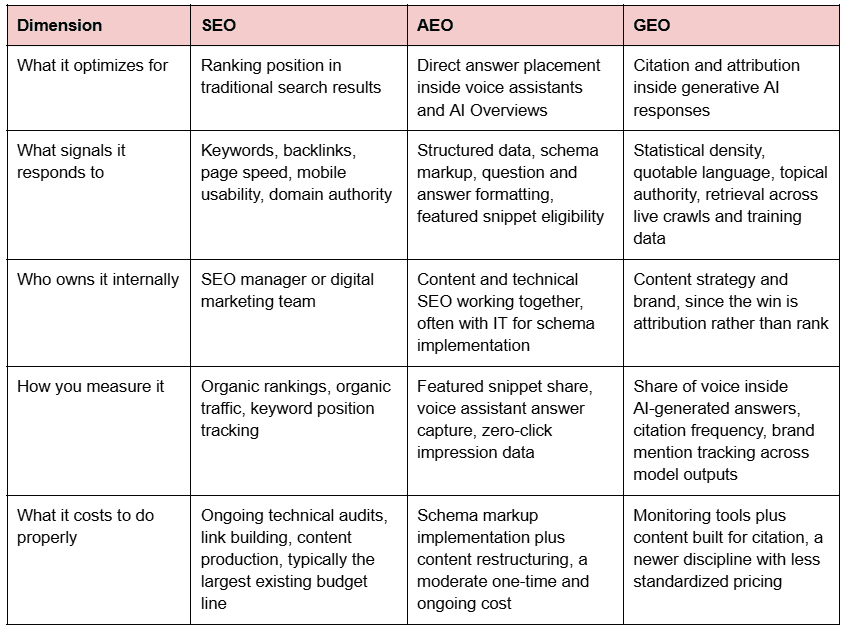
What it optimizes for:
SEO: Ranking position in traditional search results
AEO: Direct answer placement inside voice assistants and AI Overviews
GEO: Citation and attribution inside generative AI responses
What signals it responds to:
SEO: Keywords, backlinks, page speed, mobile usability, domain authority
AEO: Structured data, schema markup, question and answer formatting, featured snippet eligibility
GEO: Statistical density, quotable language, topical authority, retrieval across live crawls and training data
Who owns it internally:
SEO: SEO manager or digital marketing team
AEO: Content and technical SEO working together, often with IT for schema implementation
GEO: Content strategy and brand, since the win is attribution rather than rank
How you measure it:
SEO: Organic rankings, organic traffic, keyword position tracking
AEO: Featured snippet share, voice assistant answer capture, zero-click impression data
GEO: Share of voice inside AI-generated answers, citation frequency, brand mention tracking across model outputs
What it costs to do properly:
SEO: Ongoing technical audits, link building, content production, typically the largest existing budget line
AEO: Schema markup implementation plus content restructuring, a moderate one-time and ongoing cost
GEO: Monitoring tools plus content built for citation, a newer discipline with less standardized pricing
Where Do SEO, AEO, and GEO Overlap?
All three disciplines depend on the same foundation: a fast, well-structured website full of content answering real questions.
A page written for SEO with clear headers, direct answers, and credible sourcing already does most of the work AEO and GEO need. A business rebuilding content for one discipline finishes most of the work for the other two, without spending extra budget.
Topic alignment sits at the center of all three. Search engines, answer engines, and generative engines each reward a business demonstrating depth on a subject over one scattering thin pages across dozens of keywords. The single biggest lever across SEO, AEO, and GEO stays the same: build fewer, deeper pages instead of more, shallower ones.
Where Do Teams Waste Money Treating Them as Separate Budgets?
Teams waste money hiring three vendors to solve one content problem. A business paying an SEO agency for keyword research, a separate consultant for schema markup, and a GEO monitoring tool for citation tracking often ends up with three reports measuring three different things and no shared plan connecting any of them.
That Random Agency recommends combining SEO, AEO, and GEO under one content strategy with one owner, then splitting tactical execution, schema implementation, and technical monitoring across whichever team already holds the relevant skill. Duplicate content audits rank as the most common waste. Duplicate monitoring subscriptions rank second. A business rarely needs three separate platforms tracking overlapping keyword sets when one consolidated dashboard, paired with a shared editorial calendar, covers the same ground for less money.
That Random Agency recommends starting the audit with a single question: does the current content answer a real question completely enough for a person, a voice assistant, and a language model to reuse the answer without editing? Content passing this bar tends to perform across all three disciplines already.
Frequently Asked Questions
Is GEO the same thing as SEO?
No. SEO optimizes for ranking position in traditional search results. GEO optimizes for citation inside answers generated by tools such as ChatGPT and Claude. Most businesses need both, and each uses a different measurement.
Do I need AEO if I already do SEO?
Yes, if a business wants to appear inside voice assistant answers and AI Overviews rather than only inside a list of ranked links. AEO builds on an SEO foundation but adds schema markup and answer formatting SEO alone does not require.
How much does GEO cost?
Costs vary because the discipline is newer and less standardized than SEO pricing. Most businesses budget for content restructured around citable data plus a monitoring tool tracking brand mentions across AI-generated answers, adding to an existing SEO budget rather than replacing the budget.
What is the difference between an answer engine and a generative engine?
An answer engine, such as Google's AI Overviews or Alexa, pulls a single answer from an existing page and reads the answer back. A generative engine, such as ChatGPT or Claude, synthesizes an answer from many sources and does not always name the business supplying the information.
Does ChatGPT cite my website without SEO?
Rarely. A generative engine still needs a page to exist, load fast, and demonstrate expertise on a topic before citing the page as a source, all foundations SEO already builds. GEO adds the layer of writing content in a citable, statistic-rich format on top of this foundation.
Does GEO replace SEO?
No. GEO adds a new form of visibility on top of an SEO foundation. A page with poor technical SEO, slow load times, thin content, weak site structure, rarely gets cited by a generative engine regardless of how well the page is written for citation.
What does a ChatGPT citation of my business mean?
A citation means a generative engine retrieved a page from a business, judged the page trustworthy and relevant enough to use, and named the business as a source, either in text or through a linked citation, when generating a response to a user's question.
More blogs.
Explore our collection of insights — from quick, actionable tips to in-depth explorations of design, development, and the evolving world of digital work.