How We Took a B2B Software Brand From Invisible to Cited in AI Search
How a B2B software brand went from zero AI search visibility to being cited across 20+ LLMs, and what it took to get there.

Lauren Patterson
//
CEO & Co-founder

When a buyer asks ChatGPT, Perplexity, or Gemini for the top sales intelligence software in government contracting, your product must show up as an answer.
Earlier this year, Cloverleaf AI (a software company that sells government sales intelligence to B2G teams) faced a serious visibility issue. AI models could not find or cite their pages. Worse, when AI engines did mention the brand, they confused Cloverleaf AI with a team-coaching tool that shares the same name. Instead of listing Cloverleaf AI alongside government sales tools, AI models recommended HR software like Workday and SuccessFactors.
In June 2026, That Random Agency brought in Lighthouse, our proprietary AI tracking software, to audit Cloverleaf AI and fix their content.
Here is how we doubled Cloverleaf AI's AI citability score in two months, fixed their identity problem, and turned their site into a trusted source for AI search engines.
The Business Problem: AI Identity Confusion
Search engines rank pages so humans can click blue links. AI engines read pages so they can quote facts directly.
Our initial baseline scan on May 27, 2026, covered 20+ AI models and revealed three main problems:
Overall GEO Citability Score: 16 out of 100.
Core Product Pages: Every core page scored in the "Critical" range for AI readability.
Brand Confusion: AI platforms filed Cloverleaf AI under HR software and compared it to Workday and SuccessFactors.
Because Cloverleaf AI lacked clear technical signals, AI models could not quote its pages with confidence. The brand was missing from the AI search path entirely.
We set a nine-month target to raise their citability score from 16 to 35. By fixing their page structure, we hit a 34 GEO score in two months.
The Results: Before and After
Our Lighthouse AI Visibility Intelligence scans showed clear gains between May 27 and August 5, 2026:
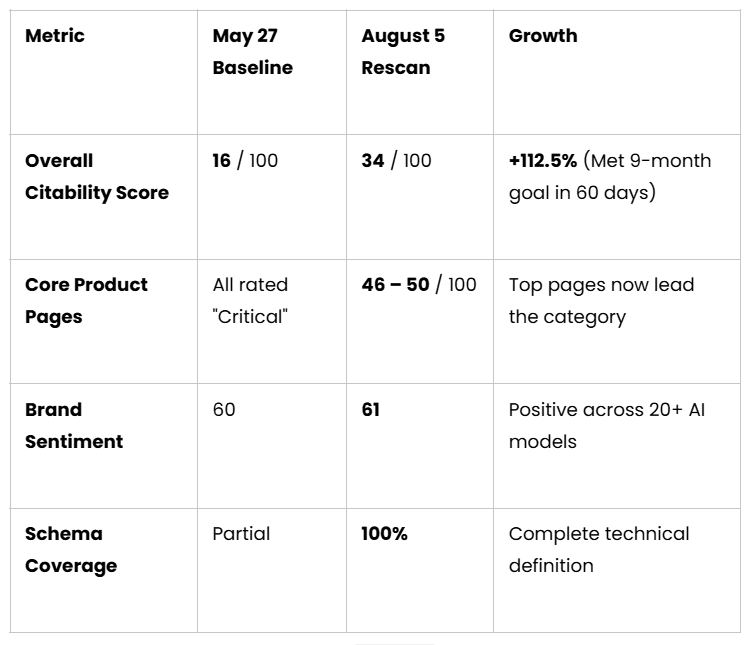
Overall Citability Score:
May 27 Baseline: 16 out of 100
August 5 Rescan: 34 out of 100
Growth: +112.5% (met 9-month goal in 60 days)
Core Product Pages:
May 27 Baseline: All rated "Critical"
August 5 Rescan: 46-50 out of 100
Growth: Top pages now lead the category
Brand Sentiment:
May 27 Baseline: 60
August 5 Rescan: 61
Growth: Positive across 20+ AI models
Schema Coverage:
May 27 Baseline: Partial
August 5 Rescan: 100%
Growth: Complete technical definition
The Four Tactics That Fixed Cloverleaf AI in 60 Days
If you manage marketing for a software brand, these four tactics will show you how to fix your own AI visibility.
1. Fixed Schema Code
AI engines use structured data (JSON-LD code) to understand real-world entities. To end the confusion between Cloverleaf AI and the coaching app, we added full organizational and product code across 100% of the site.
We clearly tagged their industry as government sales intelligence. This broke the link to Workday and SuccessFactors and told AI engines exactly where Cloverleaf AI belonged.
2. Built Clear Answer Capsules
AI models do not read landing pages like human visitors do. They look for short, clear statements they can pull into an answer box.
We wrote 40-to-60-word Answer Capsules at the top of key product pages. Each capsule defines what the software does in direct prose. Placing these dense summaries at the top of each page gave AI models facts they could cite immediately.
3. Removed Spam Links and Added Citation Hooks
AI models judge trust by link quality and consistent facts. Cloverleaf AI had old, low-quality links that hurt its standing.
We removed bad links and cleaned up their link profile. At the same time, we added structured Citation Hooks (short tables, clear FAQs, and direct facts) that AI web crawlers prefer to grab.
4. Built Comparison Pages
Buyers often ask AI: "How does Product A compare to Product B?" If you do not publish that comparison yourself, AI models will guess or pull answers from review sites.
We built dedicated competitor comparison pages. These pages use clear comparison tables, allowing AI models to pull exact specs when buyers evaluate Cloverleaf AI against other government sales tools.
Measuring the Impact
Without clear entity signals and structured content, Cloverleaf AI was missing from conversational buyer searches. Within 60 days of using this framework, their core product pages changed from invisible pages into main citation sources for AI engines evaluating B2G sales tools.
The data shows three main shifts across GEO metrics:
Category Ownership: AI models stopped filing Cloverleaf AI under HR tools and began associating the brand with government sales intelligence peers.
Entity Trust: Core B2G product pages left the "Critical" tier (0 to 39) and climbed into high citability scores ranging from 46 to 50.
Speed to Value: Reaching a 34 overall GEO score in two months delivered nine months of planned growth in under 60 days.
What We Would Do Differently
Most agency case studies sound easy. The work of optimizing for changing AI engines is harder in practice. Here is what we learned along the way:
Identity Fixes Take Time to Spread: You can update code in an afternoon, but AI models do not update their memory immediately. It took nearly five weeks for ChatGPT and Claude to stop confusing Cloverleaf AI with HR tools, even though Google reindexed the pages quickly.
On-Page Changes Have Limits: Our August 5 rescan hit our target score of 34, but it showed a clear cap. On-page updates can only do so much if the rest of the web lacks facts about your brand. To pass a score of 50, Cloverleaf AI needs off-page work, including fresh blog content, a new homepage, and a public glossary.
Standard Meta Updates Do Less in AI Search: In classic search engine work, meta descriptions matter a lot. In AI search, models skip meta descriptions and read page headings, bullet points, and main text. If we started over today, we would skip meta tweaks and rebuild page content first.
Next Steps for Cloverleaf AI
With baseline visibility secured, phase two focuses on growth:
Blog Refresh: Rewriting older posts based on gap data.
B2G Glossary: Building a clear glossary of government sales terms that AI models can quote.
Clean Site Hierarchy: Removing duplicate signals across product pages.
Frequently Asked Questions (FAQ)
What is the difference between SEO and GEO?
Traditional SEO helps your site rank higher in Google search results to earn clicks. GEO (Generative Engine Optimization) structures your content so AI engines (like ChatGPT, Perplexity, and Gemini) can read, trust, and quote your brand directly.
How do AI search engines choose what to cite?
AI models pick citations based on page layout, structured code, clear sources, and factual copy. Pages with clean headers, brief summary blocks, and precise code score highest.
What is an Answer Capsule?
An Answer Capsule is a short section of text (usually 40 to 60 words) placed on a webpage to answer a single question clearly. It is written so AI models can copy and quote it verbatim.
How long does it take to fix brand confusion in AI search?
Code updates take effect quickly, but it usually takes 30 to 60 days for AI models to update their index and stop confusing your brand with other companies.
More blogs.
Explore our collection of insights — from quick, actionable tips to in-depth explorations of design, development, and the evolving world of digital work.